
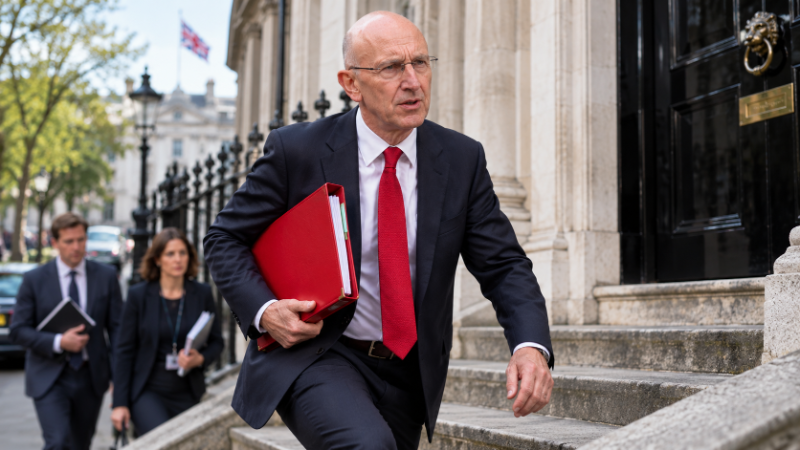
Chancellor John Healey’s Budget announcement on 28 October 2026 confirmed significant changes to the UK State Pension, including a 3.9% payment increase from April 2027, a new tax reduction for lower-income pensioners and a major adjustment to the triple-lock system from 2030.
The full new State Pension will increase to £250.70 per week, equivalent to £13,036.40 annually, while the full basic State Pension will rise to £192.10 per week.
However, the increase creates an unusual tax situation because the full new State Pension will exceed the frozen £12,570 Personal Allowance for the first time.
To address this, the Chancellor announced a Pension Tax Allowance worth up to £94 in 2027/28, potentially benefiting around 500,000 pensioners.
Our analysis of the Budget documents shows that the headline increase is only part of the story. Pensioners with small private pensions, part-time earnings or savings interest could face different tax outcomes depending on their total income.
What Did John Healey Announce About the State Pension in Budget 2026?
John Healey presented his first Budget as Chancellor of the Exchequer on 28 October 2026. Among the pension-related measures, the government confirmed changes affecting payments, taxation and the long-term financing of retirement benefits.
The main announcements were:
- 3.9% State Pension increase: Both the full new and basic State Pension rates will rise from April 2027.
- New Pension Tax Allowance: Eligible pensioners will receive an income tax reduction worth up to £94 in 2027/28.
- Income protection: Pensioners with total annual income up to approximately £13,037 will not pay Income Tax under the new arrangements.
- Triple-lock adjustment: From April 2030, annual increases will use a revised formula designed to protect pension values relative to earnings over time.
- National Care Service: Savings from the revised triple lock are intended to help finance free personal care for eligible older people in England.
- Pensions Commission: A final report on the adequacy and sustainability of private pensions is scheduled for February 2027.
The Government Actuary’s Department Budget 2026 technical bulletin confirms the pension announcements and their implications for the public finances.
The Budget therefore combines an immediate increase in pension payments with measures affecting how retirement income is taxed and how future State Pension increases are calculated.
How Much Will the State Pension Increase From April 2027?
The Department for Work and Pensions confirmed that the full new and basic State Pensions will rise by 3.9%, reflecting average earnings growth for the May–July 2026 measurement period.
New State Pension Rates for 2027/28
| Payment | 2026/27 | 2027/28 | Increase |
| Weekly State Pension | £241.30 | £250.70 | £9.40 |
| Four weeks | £965.20 | £1,002.80 | £37.60 |
| Annual amount (52 weeks) | £12,547.60 | £13,036.40 | £488.80 |
| Percentage increase | — | — | 3.9% |
A pensioner receiving the full new State Pension throughout the 2027/28 year will therefore receive approximately £489 more before any applicable tax.
This is the standard new State Pension rate, generally applicable to people who reached State Pension age on or after 6 April 2016.
However, the actual amount received depends on individual National Insurance records, qualifying years and any relevant adjustments.
Basic State Pension Rates for 2027/28
People who reached State Pension age before 6 April 2016 generally fall under the older State Pension system.
| Payment | 2026/27 | 2027/28 | Increase |
| Weekly basic State Pension | £184.90 | £192.10 | £7.20 |
| Four weeks | £739.60 | £768.40 | £28.80 |
| Annual amount (52 weeks) | £9,614.80 | £9,989.20 | £374.40 |
| Percentage increase | — | — | 3.9% |
The basic State Pension will increase by approximately £374 annually.
Some recipients of the older system also receive Additional State Pension, which is calculated separately and may have different uprating arrangements.
Importantly, the rates above are headline amounts. Not every pensioner receives the full weekly rate, and the annual comparisons assume 52 weeks of entitlement.
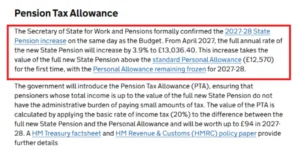
Official confirmation of the 3.9% State Pension increase and the £13,036.40 annual full new State Pension for April 2027.
Why Has John Healey Introduced a New Pension Tax Allowance?
One of the most important parts of John Healey’s State Pension Budget announcement concerns the interaction between pension increases and frozen income tax thresholds.
The standard Personal Allowance remains £12,570 for 2027/28.
Meanwhile, the full new State Pension will reach £13,036.40.
That creates the following difference:
| Tax calculation | Amount |
| Full new State Pension in 2027/28 | £13,036.40 |
| Standard Personal Allowance | £12,570.00 |
| Income above Personal Allowance | £466.40 |
| Illustrative 20% tax on difference | £93.28 |
| Maximum announced tax reduction | Up to £94 |
Without additional relief, a pensioner receiving only the full new State Pension could face an Income Tax liability of approximately £93 annually.
The Chancellor’s new Pension Tax Allowance is intended to prevent this outcome for those on the lowest incomes.
The important distinction is that the government is introducing a tax reduction rather than increasing the normal Personal Allowance.
This means the standard £12,570 Personal Allowance remains unchanged, but eligible pensioners can have part or all of their calculated Income Tax liability cancelled.
The measure is particularly important because the State Pension has always been taxable income, although it is generally paid without tax being deducted directly.
Who Will Qualify for the Pension Tax Allowance?
The relief is available to qualifying individuals above State Pension age, including those who reach State Pension age during the relevant tax year.
Eligibility is determined by total income rather than whether someone receives the full new State Pension.
This means the reduction can also apply to pensioners receiving:
- The older basic State Pension.
- A partial new State Pension.
- An occupational or private pension.
- Employment or self-employment earnings.
- A combination of taxable retirement income sources.
People receiving no State Pension because they have deferred claiming it may still qualify if they satisfy the age and income conditions.
According to HM Treasury’s Pension Tax Allowance Explainer, the relief will be applied automatically using information already held by HMRC.
Eligible pensioners will not need to submit a separate application.
How Will the New Pension Tax Allowance Work in 2027/28?
The government has established income thresholds determining how much relief eligible pensioners can receive.
| Annual total income | Pension Tax Allowance treatment |
| Below £12,570 | Normally no Income Tax liability to offset |
| £12,570 to £13,037 | Full relief available, up to the tax due |
| Above £13,037 but below £13,319 | Relief gradually withdrawn |
| £13,319 or more | No Pension Tax Allowance |
The maximum tax reduction is approximately £94 during 2027/28.
However, pensioners with income slightly above the full new State Pension can still receive partial relief.
How the £1-for-£3 Taper Works?
For every £3 of total income above the qualifying threshold, £1 of the Pension Tax Allowance is withdrawn.
For example, consider a pensioner whose annual income is approximately £150 above the full new State Pension.
The calculation is:
- Starting maximum tax reduction: approximately £94.
- Additional income above the qualifying level: £150.
- Reduction in tax relief: £150 ÷ 3 = £50.
- Remaining Pension Tax Allowance: approximately £44.
The individual would therefore still receive a tax reduction of around £44.
Once income reaches approximately £13,319, the relief disappears.
The published thresholds are rounded, so precise individual calculations may differ slightly.
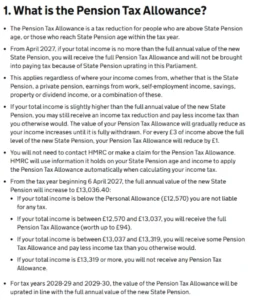
HM Treasury’s official Pension Tax Allowance eligibility thresholds, showing full relief up to £13,037 and complete withdrawal at £13,319.
Could Pensioners Pay More Tax When Their Income Increases?
Yes. One less obvious feature of the new system is that small increases in income within the tapering range can cause a proportionately larger increase in tax.
MoneySavingExpert founder Martin Lewis explained the issue on ITV’s The Martin Lewis Money Show Live on 29 October 2026.
He illustrated the effect by stating:
“£99 of income more, £52 of tax more.”
His example highlights the interaction between normal Income Tax and the gradual withdrawal of the pensioner tax reduction.
For a pensioner paying the standard 20% basic rate, each additional £3 of income within the tapering range can generate approximately:
- 60p in ordinary Income Tax.
- £1 of withdrawn Pension Tax Allowance.
- A combined £1.60 increase in tax.
That produces an effective marginal tax rate of approximately 53.3% across much of the tapering range.
This does not mean all of a pensioner’s income is taxed at 53.3%.
It means that additional income earned within this narrow band can face a relatively high effective rate after the loss of relief.
The distinction matters for pensioners considering extra part-time work or additional taxable pension withdrawals.
What Do the Budget Changes Mean for Different Pensioners?
To understand the practical effect, we have compared several illustrative income situations.
The following examples assume the 2027/28 rules, a full standard Personal Allowance, ordinary pension income taxed at 20% and no other relevant tax adjustments.
| Annual income | Tax before new relief | Approx. tax after relief |
| £12,500 | £0 | £0 |
| £12,900 | £66 | £0 |
| £13,036.40 | £93.28 | £0 |
| £13,150 | £116 | About £60 |
| £13,400 | £166 | £166 |
These are simplified examples, not personalised tax calculations.
Example 1: A pensioner receiving only the full new State Pension
A pensioner receives £13,036.40 annually and has no other income.
Under normal basic-rate calculations, £466.40 of income would exceed the Personal Allowance.
The tax due would be £93.28.
The Pension Tax Allowance would offset this liability, leaving no Income Tax to pay.
Example 2: A pensioner with a small private pension
Suppose a retiree receives £10,800 from the State Pension and £2,100 from an occupational pension.
Their combined annual income would be £12,900.
Although this is £330 above the standard Personal Allowance, the Pension Tax Allowance would remove the resulting £66 Income Tax liability.
Example 3: A pensioner earning extra income
Consider someone receiving £13,150 annually from a combination of pension payments and part-time employment.
Their normal basic-rate tax liability would be £116.
However, their Pension Tax Allowance would be partially reduced because their income exceeds the qualifying threshold.
Their remaining Income Tax liability would be approximately £60.
This demonstrates why earning slightly more does not necessarily produce the same net income increase that someone might expect from the ordinary 20% tax rate.
Will Savings Interest Affect the New Pension Tax Allowance?
Savings interest introduces an important complication that pensioners should understand.
The Pension Tax Allowance is assessed using total income, not simply income on which tax is ultimately charged.
That means some income can affect the reduction even when a separate tax rule prevents Income Tax being charged directly on that income.
Example: £100 Savings Interest Outside an ISA
Consider someone who receives:
- Full new State Pension: £13,036.40.
- Bank savings interest: £100.
- Combined total income: £13,136.40.
Assume the £100 interest qualifies for a 0% savings rate under the person’s existing savings tax allowances.
Although the interest itself may not produce an additional Income Tax charge, it can still count towards total income when HMRC calculates the Pension Tax Allowance taper.
In this simplified example, the extra £100 reduces the available tax credit by approximately £33.33.
That could leave an Income Tax liability of around £33, despite the savings interest itself being taxed at 0%.
The precise outcome depends on the individual’s wider tax position.
What About Cash ISAs and Other Tax-Free Income?
Interest earned within a Cash ISA is generally excluded from taxable income and does not count towards the Pension Tax Allowance income threshold.
This creates a potentially important difference between holding savings inside and outside an ISA.
Other amounts that generally do not form part of total income for this purpose include Premium Bonds prizes, qualifying tax-free pension lump sums and tax-free disability benefits.
The distinction could become increasingly relevant as pension payments rise while normal tax thresholds remain frozen.
It is also worth remembering that the Budget separately increases the basic Income Tax rate on taxable savings interest from 20% to 24% in April 2027, although existing savings allowances continue to matter.
How Many Pensioners Will Benefit From John Healey’s Budget Tax Changes?
The government’s impact assessment provides estimates of how many people could benefit from the Pension Tax Allowance.
| Government estimate | 2027/28 | 2029/30 |
| Pensioners benefiting from some tax reduction | Around 500,000 | Around 1 million |
| Pensioners taken out of paying Income Tax | Around 290,000 | Almost 600,000 |
HMRC also estimates that more than 200,000 pensioners will avoid receiving a Simple Assessment tax bill in 2027/28 that they would otherwise have received.
This is a particularly relevant administrative benefit.
State Pension payments normally arrive without Income Tax being deducted at source. For people without another taxable pension or employment income, HMRC may have to collect tax separately.
Avoiding small annual tax liabilities could therefore reduce paperwork and confusion for pensioners who are unfamiliar with the tax collection process.
What Is the Estimated Cost of the Tax Relief?
HMRC’s Budget impact assessment sets out the following projected costs to the Exchequer:
| Financial year | Estimated reduction in tax receipts |
| 2027/28 | £45 million |
| 2028/29 | £90 million |
| 2029/30 | £150 million |
These projections show that the measure becomes more expensive as State Pension payments continue increasing and more pensioners become eligible.
However, the costs are modest compared with overall public spending on the State Pension.
The assessment also identifies an estimated £3.5 million of HMRC technology implementation costs.
Will the State Pension Triple Lock Change in 2030?
Yes. The Budget confirmed the government’s previously announced plan to introduce an adjusted triple-lock formula from April 2030.
Under the current system, the basic and full new State Pension increase annually by whichever is highest:
- Consumer Prices Index inflation.
- Average earnings growth.
- A minimum 2.5% increase.
This formula has provided significant increases in some years, particularly when inflation or earnings growth has been unusually high.
However, the government argues that the system can gradually push pension spending higher relative to average earnings because increases compound over time.
How the Adjusted Triple Lock Will Work?
From April 2030, the new approach will increase the State Pension by the highest of:
- CPI inflation.
- 2.5%.
- The increase required to maintain or restore its protected value relative to average earnings, using the level reached in April 2029.
The distinction is important.
The State Pension will still increase every year under the announced formula, but it will no longer automatically receive the full annual earnings growth percentage whenever that exceeds inflation and 2.5%.
Instead, the earnings component is designed to preserve its value relative to wages over time.
For example, suppose average earnings increase by 5% while CPI inflation is 2%.
Under the current triple lock, the State Pension would increase by 5%.
Under the adjusted system, the payment would receive at least 2.5%, but the precise increase would depend on what was necessary to maintain or restore the protected State Pension-to-earnings relationship.
This example illustrates the mechanism rather than predicting a future increase.
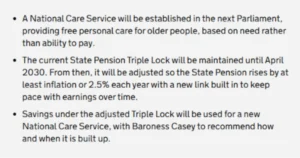
Government confirmation of the adjusted triple-lock formula from April 2030 and its connection to the proposed National Care Service.
Why Is the Government Changing the Triple Lock?
The government expects the new formula to reduce the long-term growth of State Pension expenditure compared with retaining the existing mechanism indefinitely.
The Chancellor’s Budget speech estimated that the change could produce savings of around:
| Period | Government’s estimated annual saving |
| End of the 2030s | £15 billion |
| Around 2050 | £50 billion |
These are long-term policy estimates rather than guaranteed annual savings.
Actual outcomes will depend on inflation, wage growth, the number of pensioners and other economic assumptions.
The government intends to use savings from the adjusted triple lock to support the development of a National Care Service in England.
The proposed service would provide personal care free at the point of use for eligible older people, with implementation phased according to available resources and capacity.
However, the State Pension adjustment and the National Care Service are separate reforms, each requiring its own implementation arrangements.
As of early November 2026, the revised triple lock is a confirmed government policy commitment, but the legal framework and operational details are not yet fully implemented.
What Have Financial Experts Said About the Budget’s Pension Changes?
The new Pension Tax Allowance has attracted attention because it protects lower-income pensioners while introducing additional complexity into the tax system.
Helen Morrissey, Head of Retirement Analysis at Hargreaves Lansdown, discussed the measures in her analysis published on 29 October 2026.
She welcomed the potential relief from additional tax administration but warned that the new arrangements could make an already complicated system even more difficult for pensioners to understand.
That concern is relevant because the relief does not operate like an ordinary increase in the Personal Allowance. Its withdrawal depends on total income, creating different outcomes for people with otherwise similar pension arrangements.
Martin Lewis has separately highlighted the high effective marginal tax rate within the tapering range.
Together, these professional assessments identify two competing outcomes: a reduction in small tax liabilities for lower-income pensioners, but more complex calculations for those receiving slightly higher incomes.
Our analysis suggests that communication from HMRC will be particularly important. Pensioners need to know not only whether they qualify but also why extra savings interest or pension income might reduce their relief.
Does the State Pension Budget Announcement Affect Private Pensions?
The 3.9% increase applies to the relevant State Pension rates rather than automatically increasing workplace or private pension payments.
Those pensions follow their own scheme rules.
For example, a defined benefit pension might increase according to a scheme-specific inflation formula, while withdrawals from a defined contribution pension depend on available funds and the person’s choices.
However, private pension income can affect eligibility for the new Pension Tax Allowance because it generally contributes to total income.
The government is also continuing its wider review of the pension system.
The Pensions Commission is expected to publish its final report in February 2027, examining how to improve retirement adequacy, fairness and long-term sustainability.
Separate tax changes affecting inherited pensions are also scheduled for April 2027. Those should not be confused with the new Pension Tax Allowance for living pensioners.
When Will the State Pension and Tax Changes Take Effect?
Not all the announced reforms begin on the same date.
| Date | Expected change |
| 28 October 2026 | Chancellor announces Budget pension measures |
| 6 April 2027 | Pension Tax Allowance begins for the 2027/28 tax year |
| April 2027 | State Pension rises by 3.9%, with most revised weekly benefit rates taking effect from 12 April |
| February 2027 | Pensions Commission’s final report scheduled for publication |
| 2028/29 | Pension Tax Allowance scheduled to continue with an updated value |
| 2029/30 | Third tax year covered by the announced allowance |
| April 2030 | Adjusted triple-lock formula scheduled to begin |
The Pension Tax Allowance has been announced for three tax years, ending on 5 April 2030.
The government has stated that arrangements beyond this period will be considered separately.
Therefore, it would be incorrect to assume either that the allowance has been made permanent or that all pensioners will automatically face tax bills from April 2030.
Future decisions will determine what replaces or extends the relief.
What Should Pensioners Check Before April 2027?
Pensioners who could be affected by the changes should review their overall retirement income rather than concentrating solely on their weekly State Pension payment.
The most useful checks include:
- State Pension entitlement: Confirm the actual payment expected, particularly where the full standard rate does not apply.
- Combined taxable income: Add together relevant State Pension, private pension and employment income.
- Savings interest: Check whether taxable savings interest outside ISAs affects total income for the allowance.
- HMRC tax code: Review any changes once the new system is implemented.
- Pension Credit: Check eligibility separately, as the Pension Tax Allowance is an income tax measure rather than a replacement for means-tested support.
- Tax correspondence: Read any HMRC notice carefully, particularly where several income sources are involved.
HMRC expects the new tax reduction to be applied automatically.
Pensioners already completing Self Assessment returns will generally continue to do so where they have other reasons to file.
Those with employment or occupational pension income may see the change reflected through PAYE coding adjustments.
People should not assume that receiving a State Pension increase automatically makes them liable for tax. The result depends on their total income and individual circumstances.
Frequently Asked Questions
How much will the State Pension increase following John Healey’s Budget?
The full new State Pension will rise by 3.9% to £250.70 per week from April 2027. That represents an annual increase of £488.80 when calculated over 52 weeks.
Will pensioners pay Income Tax on their State Pension in 2027?
The State Pension remains taxable income. However, the new Pension Tax Allowance means qualifying pensioners with total annual income up to approximately £13,037 should not have Income Tax to pay under the announced arrangements.
What is the £94 Pension Tax Allowance?
It is a tax reduction worth up to approximately £94 in 2027/28. It reduces eligible pensioners’ Income Tax liabilities rather than providing an additional cash payment.
Does the Pension Tax Allowance apply to the old State Pension?
Yes. Eligibility depends on State Pension age and total income, not solely on receiving the new State Pension. Recipients of the older basic State Pension can qualify.
Do pensioners need to apply for the new allowance?
No. HMRC has confirmed that the relief will be applied automatically using available age and income information.
Is the triple lock being abolished in 2030?
No. The government plans to adjust the formula from April 2030. The State Pension will continue rising by at least the higher of CPI inflation or 2.5%, with an additional earnings-related protection mechanism.
Will the new Pension Tax Allowance continue after 2030?
The announced measure covers the 2027/28, 2028/29 and 2029/30 tax years. The government has not yet confirmed what arrangements will apply beyond April 2030.
